Pisco Sour: The Story Behind Peru's Most Famous Cocktail
A small coupe, a pale yellow body, a thin foam crown, three drops of bitters. Behind that quiet glass is more than a century of Lima history — and a recipe travelers cross half the world to taste at the source.
Where it began
The most-cited origin places the Pisco Sour at Morris Bar on Jirón Boza in central Lima, around 1916. The bar was run by Víctor Vaughen Morris, an American who had come south for the railways and stayed for the bar life. His Peruvian bartenders — chief among them Mario Bruiget, a young chiclayano — adapted the American whiskey sour to local ingredients, swapping in pisco, egg white, and Angostura bitters.
The drink jumped to the Hotel Maury and the Gran Hotel Bolívar, and by the 1940s it was Peru's de facto national cocktail. Today the first Saturday of February is National Pisco Sour Day — a public holiday everyone in Lima quietly takes seriously.
What's actually in it
A classic Pisco Sour is built on a 3-1-1 ratio:
- 3 parts pisco — usually Quebranta, a non-aromatic grape
- 1 part fresh lime juice — never bottled, always squeezed minutes before
- 1 part simple syrup — equal sugar and water, dissolved
- One fresh egg white per drink
- Ice — shaken hard
- 3 drops of Angostura bitters on the foam
That's it. No vanilla, no infusions, no garnish. The discipline is the point.
What makes pisco different
Pisco isn't tequila and it isn't European brandy — though it sits in the brandy family. It's a grape distillate, unaged, and protected by Peru's Denomination of Origin. Legally it can come from only five regions: Ica, Lima, Arequipa, Moquegua, and Tacna.
Four styles you'll meet at any Lima bar:
- Quebranta — the workhorse non-aromatic; clean, slightly earthy. Built for sours.
- Italia — fragrant Muscat-derived; floral. Better sipped neat or in a Chilcano.
- Acholado — a blend of varieties; rounder.
- Mosto Verde — distilled from partially fermented must; richer, more expensive.
How to drink it like a local
- Drink it fresh. Egg white doesn't keep. After a few minutes the foam separates and the texture falls apart.
- Don't stir. Sip through the foam — the bitters on top are part of the design.
- One is plenty before a meal. A second goes well after, with dessert.
- Order one alongside ceviche. The acidity matches and the cold tightens the fish.
Make it yourself in Lima
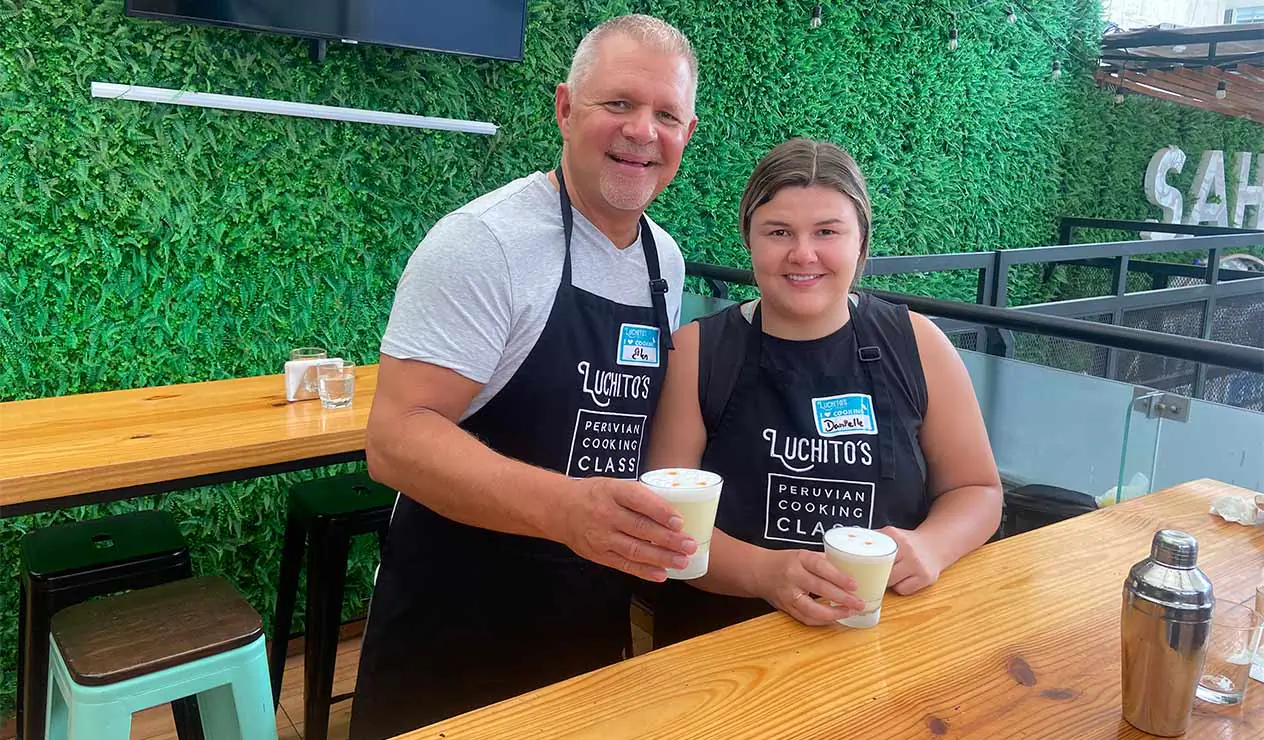
The best way to actually understand a Pisco Sour isn't to read about it — it's to shake one yourself, at room temperature, with a Limeño bartender adjusting your grip. In our hands-on classes in Miraflores, the Pisco Sour is the first thing students mix; by the time the ceviche is plated, you'll have one in your hand that you made.
We don't water down the ratio for the class. What you learn is what you'd be served at Hotel Maury, on the same marble counter where it spent the 1940s.
Shake your first Pisco Sour in Lima
Our Ultimate Peruvian Cooking Class includes Ceviche, Causa Limeña and the original 3-1-1 Pisco Sour. Hands-on, English-speaking chefs, two-and-a-half hours in Miraflores.
View the Ultimate Class — from $59 →